
Language Matters in Food Access Work
Food Apartheid or Food Desert? Nutrition Security or Food Security?

It’s no secret that we are in an information crisis of epic proportions. Not to sound dramatic, but it feels that way.
As I write this in 2025, MAHA (Make America Healthy Again) has run rampant, everyone thinks they need absurd amounts of protein, and many believe food dyes are the root of all their health problems (see my Substack about that here.)
But I keep coming back to the same thought: do people actually know what they’re saying?
I’d love to think that maybe they don’t, but there is a strong possibility that people are simply confused, or maybe misinformed?
So, let’s clear the air, set some ground rules, and emphasize the importance of precise language.
FOOD APARTHEID VS. FOOD DESERT
Food Desert was first coined by the Scottish Nutrition Task Force in 1995 as a part of their Low Income Project Team. As the term gained notoriety, the definition has been both adapted and contested in modern nutrition and public health circles. So much so, that it has come to encompass more than it can logically stand for.
As it is commonly defined, a food desert refers to an area that has little to no access to grocery stores, these areas also tend to be lower income. This term has become the go-to definition to describe all forms of food access issues. What I have found is that it doesn’t not accurately or adequately describe the real issues at hand. Here’s why…
What is “Food Apartheid”?
Food Apartheid, a term created by Karen Washington, better encompasses the full picture of the food system, including historical, racial, and environmental factors that lead to individuals not having adequate access to food.

In the following excerpt from an interview with Guernica Mag, Karen Washington describes the difference between the two terms:
Who in in my actual neighborhood has deemed that we live in a food desert? Number one, people will tell you that they do have food. Number two, people in the hood have never used that term. It’s an outsider term. “Desert” also makes us think of an empty, absolutely desolate place. But when we’re talking about these places, there is so much life and vibrancy and potential. Using that word runs the risk of preventing us from seeing all of those things.
“food desert” sugarcoats what the problem is. If you bring a supermarket in, it’s not going to change the problem. When we say “food apartheid,” the real conversation can begin.
Why You Should Use Food Apartheid:
Deserts are naturally occurring, people not having adequate food access is not: Deserts were not constructed, they exist, just like an ocean exists, because nature made it so. (We could go into the deep geographical reasoning for deserts, but I am not a geographer, and I notably got a D in that class my freshman year of college lol.)
Deserts are not devoid of life: There are indigenous peoples around the world, and especially in the Americas, that are based in desert geography. They have life, they have culture, they have people. When you describe an area as a food desert, you instigate the idea that 1) deserts are barren 2) the place you are referring to is barren. Both are most likely wrong.
Food Apartheid adequately addresses the intentionality of areas without adequate food access: Most areas without access to adequate food is not due to the people there, it is often due to the city layout, rural nature of a town, or lack of local governments’ investment in grocery store infrastructure or transportation. It is does with intention, and without care.
Food Apartheid acknowledges the role of systemic racism, geography, and environmental factors that impact food access: The intentionality of cutting off access to food is deeply rooted in the idea that only certain people should be afforded the luxury of food accessibility. The more we call it what it is, the more we can actually make a change.
The Very Large Umbrella of Food Security
Food security as defined by the USDA, refers to several different quantifiable variables relating to food access, ranging from High to Very Low Food Insecurity. Overall, the definition focuses on reliable access to food, including variety, desirability, and quality of said food.
(note: In the USDA definition, they define whether anxiety is tied to gaining access to food as a factor of food security, which I find vital to it’s definition.)
For example, you may live close to a grocery store, but if that store is at a high price range, is it still accessible? The answer is no, you are still vulnerable, and still considered food insecure.
Nutrition Security focuses more on the nuance within food security specifically variety and quality of the food accessible to an individual. This term focuses more on the dietary needs of individuals and nutritional adequacy.
It gives more specificity to matters relating to food access that go past having access to food. The quality of that food matters, the cultural relevancy of that food matters, the nutritional density of that food matters.
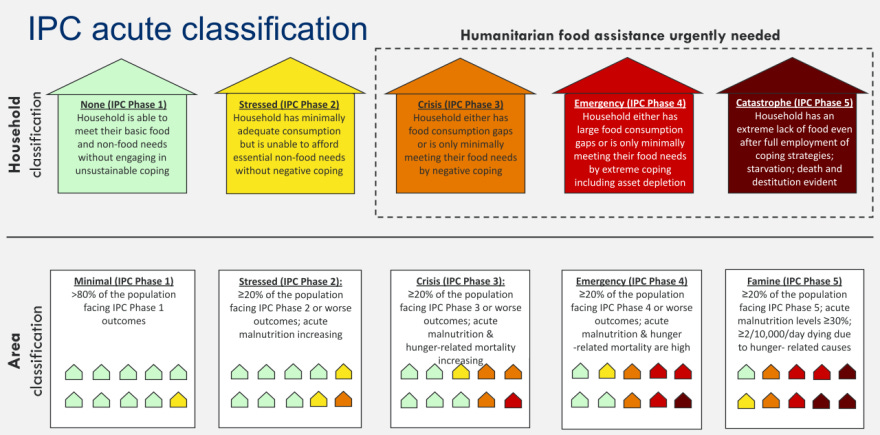
Hunger is the final term under the food security umbrella, and one that should not be used lightly as it refers directly to an individual’s physiological condition, as a result of access to food. I think hunger is a term that is used casually, but in the context of food security is incredibly serious.
The more we discuss these terms the more we can understand the gravity of individual’s going hungry around the world, especially in relation to Gaza, Tigray, and South Sudan, which have been experiencing famine at astronomical levels.
(see my instagram post on the IPC Hunger Scale).
Language Matters
As our world continues to be fall under strange and unfounded rhetoric, a return to word’s meanings feels timely. It’s okay to do a quick google, to think before you speak, and double and even triple-check what terminology you are using.
Having the words to use to call out atrocities like hunger, famine, and food apartheid are important. Knowledge is absolutely power, and the more we educate each other, the more power we have.
The more ya know, am I right?
Sources: For More Learning
Origins of Food Desert As a Term: https://pmc.ncbi.nlm.nih.gov/articles/PMC7299236/
Definition of Food Deserts: https://onlinelibrary.wiley.com/doi/abs/10.1111/j.0435-3684.2006.00217.x?casa_token=z_JaVioh-Z8AAAAA%3ACiKX29wkmZTN_mVvCEb1dICZIIm_NWWCDskkQJkGeu4SosBKSyGGzsYnBGIno0TPCV-HkXl_pzw3QQw
Food Apartheid and Cultural Contexts: https://www.nrdc.org/bio/nina-sevilla/food-apartheid-racialized-access-healthy-affordable-food
Definition of Food Apartheid: https://www.climatejusticecenter.org/newsletter/food-apartheid-explained
Full Guernica Article: https://www.guernicamag.com/karen-washington-its-not-a-food-desert-its-food-apartheid/
Definition of Nutrition Security: https://www.sciencedirect.com/topics/medicine-and-dentistry/nutrition-security
USDA Definition of Food Security: https://www.ers.usda.gov/topics/food-nutrition-assistance/food-security-in-the-us/definitions-of-food-security
IPC Hunger Scale Explained: https://fews.net/about/integrated-phase-classification
Nutrition Security Definition: https://www.sciencedirect.com/topics/medicine-and-dentistry/nutrition-security